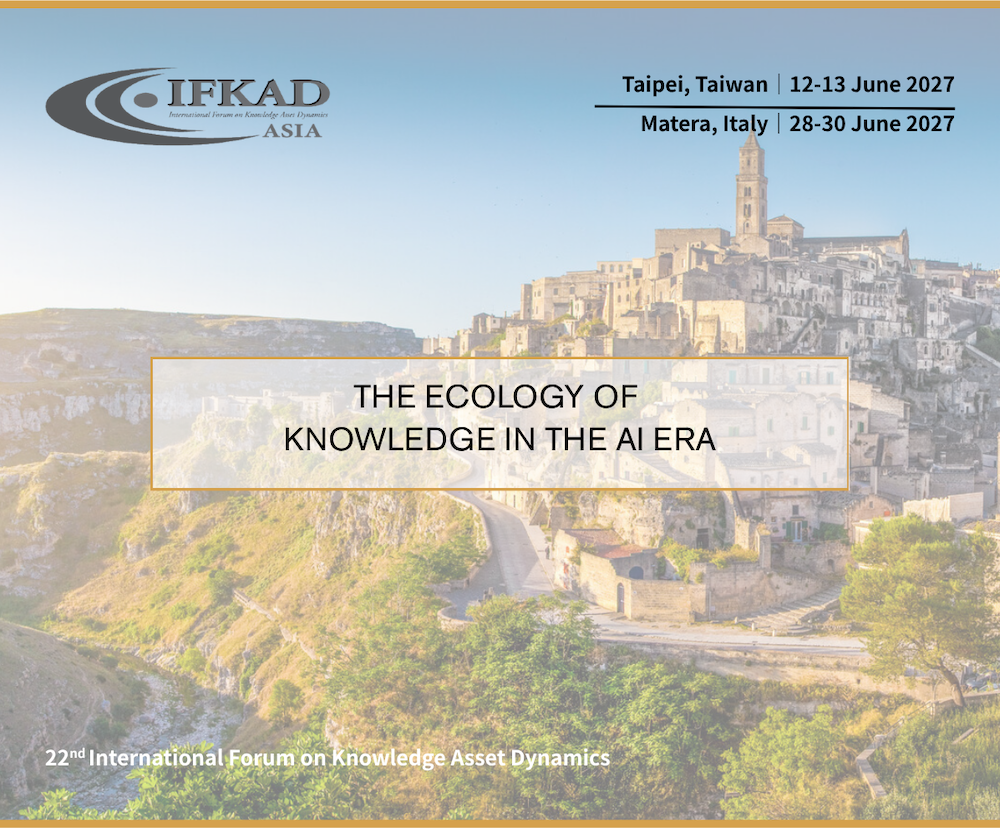
- 會議主題:The Ecology of Knowledge in the AI Era
- 全球官網及其他主題請參考:https://www.ifkad.org
- 第22屆 IFKAD Conference 國際學術研討會全球場次將於2026年6月28-30日在Matera, Italy舉行,亞洲場次6月12-13日在臺灣臺北舉行學術論文發表(會議地點為國立政治大學)。
- IFKAD Conference會議地點:University of Basilicata
- IFKAD ASIA Chapter會議地點:National Chengchi University, Taipei City, Taiwan
- 會議優秀論文可推薦投稿至國際期刊:
- IFKAD ASIA Chapter議程詳見官網:
徵稿啟事
Since its first edition, IFKAD has served as a scientific cognitive platform for scholars and practitioners committed to understanding how knowledge, as a dynamic asset, drives organisational value creation. Each year, the Forum has addressed the founding question from different perspectives: how do organisations generate, govern, and grow wealth through knowledge? For IFKAD 2027, this question addresses a fundamental disruption. Artificial intelligence is no longer an external technology applied to knowledge work; it is becoming an integral part of organisations’ cognitive architecture and knowledge ecosystem. It senses, infers, generates, and decides alongside human beings. This shift is changing how knowledge lives, circulates, and creates value.
IFKAD 2027 proposes “The Ecology of Knowledge in the AI Era” as the lens for examining this transformation. Using ecology as a lens of inquiry highlights knowledge as an ecosystem. It is a dynamic resource and a source of value creation, characterised by an interdependent system of assets populated by human minds, organisational routines, relations, cultural artefacts, and, increasingly, artificial agents. Within such an ecosystem, organisational health and wealth creation depend on diversity, balance, symbiosis, and the quality of relationships among its constituent components. An ecosystem can flourish or degrade; it can sustain a rich plurality of species or collapse into monoculture; it can be cultivated with care or exploited to exhaustion. The same, we argue, holds true for organisational knowledge in the age of AI.
The ecology of knowledge in the AI era suggests that technology cannot be considered neutral: it takes on the characteristics of those who design, finance, regulate, and use it. Applied to management, organisational development, and technology design, this observation invites broader reflection informed by the notion of integral ecology, according to which the technological, human, and moral dimensions of organisational life cannot be governed in isolation. A knowledge ecosystem that optimises for efficiency while eroding human judgement, creativity, or dignity is not, by this view, a healthy ecosystem, however productive it may appear in the short term. IFKAD 2027 places this insight at the core of knowledge management as an engine of sustainable organisational wealth creation, focusing on the vital question: how can organisations design, govern, and sustain knowledge ecosystems in which artificial intelligence and human intelligence do not merely coexist but genuinely co-create value?
A central premise of this year’s theme is that AI should not be understood solely as infrastructure or a productivity tool. Rather, as a knowledge-based technology, AI increasingly acts as an active participant in organisational cognition, sensing signals, generating hypotheses, producing content, and shaping decisions in ways that were previously the exclusive province of human knowledge workers. In this sense, AI is best understood as a partner within the organisation’s knowledge ecosystem, reshaping the organisation’s cognitive architecture: the structures, routines, and distributed capabilities through which an organisation perceives its environment, learns, and acts.
A healthy knowledge ecosystem, however, is not defined by cognitive and computational capabilities alone. Diversity, the same principle that sustains biological ecosystems, also depends on preserving plural ways of knowing, including aesthetic and artistic sensibility, tacit and embodied knowledge, and imaginative modes of enquiry that resist reduction to data and computation. As AI systems scale across industries, organisations face a genuine risk of cognitive and cultural homogenisation. IFKAD 2027 therefore invites reflection on the role of aesthetics, design, and the arts as sources of organisational creativity, innovation capacity, and resilience, which are vital, complementary members of the knowledge ecosystem alongside computational intelligence.
重要日程(亞洲場次)
2027年01月22日 論文摘要投稿截止
2027年02月26日 論文摘要錄取暨註冊費繳交通知
2027年04月15日 國際學術研討會Early-Bird Rate優惠註冊截止
2027年04月20日 論文全文曁簡報繳交截止
2027年05月25日 國際學術研討會註冊截止
2027年06月12日 2026 IFKAD ASIA Chapter 亞洲場次-國際學術研究論文發表會議(國立政治大學)
2027年06月13日 2026 IFKAD ASIA Chapter 亞洲場次-永續城鄉社會實踐參訪
2027年06月28-30日2026 IFKAD Conference 全球場次-國際學術研討會(Italy)
Submission Guidelines
Deadline for abstract submission is 22 January 2027.
Participants who wish to present their research at the IFKAD 2027 conference are welcome to send an extended abstract in editable WORD FORMAT (.doc or .docx only) according to the following guidelines and using this ABSTRACT TEMPLATE.
All abstracts will undergo a double-blind peer review and review results will be communicated to authorsnot later than 26 February 2027.
Each abstract should include:
l title of the proposed article
l authors’ information (name, affiliation, address, email – separately for each author)
l abstract text of 500-1,000 words
l max 5 keywords
l paper type (Academic/Practical)
l bibliographical references
The word count is only related to the abstract text itself. Title, authors information, keywords and references are not taken in consideration for the abstract length requirement.
亞洲論文發表場次注意事項
- 經IFKAD ASIA Chapter報名投稿「IFKAD 知識資產與管理動態學國際學術研討會」,且論文獲研討會接受者,可擇一或同時於亞洲場次(6月12-13日)與全球場次(6月28-30日)發表。
- 請將摘要/全文投稿稿件 abstract template,以WORD檔案儲存,檔名為「IFKAD ASIA 2027+發表作者中文/英文姓名」,並以EMAIL附檔方式寄至forum@iilabs.org.tw,IFKAD ASIA Chapter秘書處收。
- 懇請閱讀上述提交摘要說明。
- 論文摘要稿件須接受審查,合格稿件將由電子郵件聯繫,請於期限內繳交註冊費及提供論文全文。
- 所有稿件需未曾在任何研討會或期刊發表。
- 所有被接受的論文將提交製作研討會摘要論文集。
- 為了安排發表和收錄論文集,必須由至少一位作者完成正式註冊,且需指定唯一的發表者(例如:同一位作者只能擔任一篇論文的發表人)。
若同一位作者有多篇論文被接受發表,則每篇論文都必須各自註冊並繳交相應的費用,才能列入大會議程。
IFKAD President
Giovanni Schiuma – LUM University, ITA
IFKAD ASIA President
Min-Ren Yan – National Chengchi University, TWN
IFKAD 2027 Conference Chairmen
聯絡資訊
IFKAD ASIA Chapter秘書處
連絡信箱:forum@iilabs.org.tw
Scientific Advisory Board Committee
Anand, Amitabh – SKEMA Business School, FRA
Bassi, Antonio – SUSPI, CHE
Bolisani, Ettore – University of Padua, ITA
Bontis, Nick – McMaster University, CAN
Bounfour, Ahmed – University of Paris XI – Paris-Sud, FRA
Bruno, Giuseppe – University of Naples Federico II, ITA
Campisi, Domenico – Tor Vergata University of Rome, ITA
Canonico, Paolo – University of Naples Federico II, ITA
Carrillo, Francisco – Tecnologico de Monterrey, MEX
Corvello, Vincenzo – University of Calabria, ITA
D’Alonzo, Claudio – University of Tirana, ALB
Demartini, Paola – University of Rome Tre, ITA
De Nito, Ernesto – University of Salerno, ITA
Dragomirescu, Horatiu – Bucharest University of Economic Studies, ROM
Durst, Susanne – Reykjavik University, IS
Edvinsson, Leif – UNIC Stockholm, SWE
Edvardsson, Ingi Runar – University of Iceland, ISL
Esposito, Emilio – University of Naples Federico II, ITA
Ferreira, João J. M. – University of Beira Interior, POR
Gavrilova, Tatiana – St.Petersburg State University, RUS
Grandinetti, Roberto – University of Padova, ITA
Guthrie, James – University of Sydney, AUS
Handzic, Meliha – International Burch University, BIH
Iazzolino, Gianpaolo – University of Calabria, ITA
Jarrar, Yasar – Open Data Institute, UAE
Jones, Paul – Swansea University, UK
Kianto, Aino – Lappeenranta University of Technology, FIN
Laihonen, Harri – University of Tampere, FIN
Lee, Rongbin W.B. – The Hong Kong Polytechnic University, CHN
Lev, Baruch – New York University, USA
Lewicka, Dagmara – AGH University of Science and Technology, POL
Liebowitz, Jay – University of Maryland, USA
Lönnqvist, Antti – University of Tampere, FIN
Martínez Raya, Antonio – Polytechnic University of Madrid, ESP
Martins, Blanca – Technical University of Catalonia, ESP
Massaro, Alessandro – LUM University Giuseppe Degennaro, ITA
Miglietta, Pier Paolo – University of Salento, ITA
Min-Ren Yan – National Chengchi University, TWN
Mestre, Ana Cristina – Loughborough University London, UK
Molodchik, Mariia – National Research University Higher School of Economics, RUS
Morales-Alonso, Gustavo – Polytechnic University of Madrid, ESP
Moustaghfir, Karim – Al Akhawayn University, MAR
Neely, Andy – Cambridge University, UK
Noennig, Joeg Rainer – Dresden University of Technology, GER
Ordoñez de Pablos, Patricia – University of Oviedo, ESP
Paoloni, Paola – Sapienza University of Rome, ITA
Passerini, Katia – St.John’s University, USA
Reina, Rocco – University of Catanzaro, ITA
Reuther, Kevin – West Saxon University Zwickau, GER
Roos, Göran – VTT Technical Research Centre of Finland, FIN
Sanchéz, M. Paloma – Autonomous University of Madrid, ESP
Sanchéz Gutiérrez, José – University of Guadalajara, MEX
Scarso, Enrico – University of Padua, ITA
Schumann, Christian-Andreas – West Saxon University Zwickau, GER
Seetharam , Shanker – Centennial College, CAN
Spender, JC – Rutgers University, USA
Strazzullo, Serena – University of Naples Federico II, ITA
Sveiby, Karl-Erik – Hanken School of Economics, FIN
Tang, Yongli – Jinan University, CHN
Thomas, Asha – Wrocław University of Science and Technology, POL
Troise, Ciro – University of Turin, ITA
Tsui, Eric – Honk Kong Polytechnic University, HKG
Venkitachalam, Krishna – Ajman University, UAE
Viedma Marti, Jose Maria – Polytechnic University of Catalonia, ESP
Yigitcanlar, Tan – Queensland University of Technology, AUS
Publication Committee
Carlucci, Daniela – University of Basilicata, ITA
Laihonen, Harri – University of Tampere, FIN
Lerro, Antonio – University of Basilicata, ITA
Raimo, Nicola – LUM University, ITA
Secundo, Giusy – LUM University, ITA
Spender, JC – Rutgers University, USA
PhD Consortium Committee
Carlucci, Daniela – University of Basilicata, ITA
Citlally Torres, Gabriela – Autonomous University of Aguascalientes, MEX
Morales-Alonso, Gustavo – Polytechnic University of Madrid, ESP
Secundo, Giusy – LUM University “Giuseppe Degennaro”, ITA
IFKAD Manager
Jaroš, Gabriela – IFKAD Web & Knowledge Manager, CZE
Organizing Committee
Baldassarre, Silvia – University of Bergamo, ITA
Canonico, Paolo – University of Naples Federico II, ITA
Cavola, Manuel – Pegaso University, ITA
De Nito, Ernesto – University of Salerno, ITA
Del Vecchio, Pasquale – LUM University, ITA
Diglio, Antonio – University of Naples Federico II, ITA
Pipicelli, Eduardo – University of Naples Federico II, ITA
Primario, Simonetta – University of Naples Federico II, ITA
Santarsiero, Francesco – University of Basilicata, ITA
Organized by
University of Basilicata
Arts for Business Institute
iiLABs (industry+innovation Laboratories)
LUM University
National Chengchi University(數位賦能與ESG永續創新產學聯盟)
Associated Partners
International Association for Knowledge Management
Institute of Knowledge Asset Management